Let's Face It
I learned to love bananas.

I decided to call this blog Tunnel Vision because my mind obsesses in constricting ways. At its worst, my thoughts proceed one way: forward. One of the defining problems of my life is the struggle to slow down long enough to take an exit ramp; I am a person who barrels ahead. I’ve always thought of flexibility as a virtue, but for whatever reason –– my private German education, my repressed competitiveness, or any number of things my therapist might bring up –– I’m rigid, like a block of cement.
“My mind is made of titanium,” I told my friend once, with pride. I’d willed myself to go on a long run while hungover.
“My mind is made of sand,” she countered. “It gives easily.”
This is just a round-about way of stating God’s honest truth, which is that I am very stubborn. Some days, I love my stubbornness, like when I know running will make me feel better, no matter how awful the hangover. But the downside, and really the downside cannot be overstated, is that sometimes my mind will latch and hold onto some ridiculous notion, a stupid idea, an absurd whim. The middle ground, a concept that is totally alien to me but with which, as I’ve grown older and wiser, I’m trying to become better acquainted, is the sort of harmless, arbitrary, semi-amusing obsession I will use this blog to explore.
Consider my developing relationship with bananas. They were the first food I ever remember having a gag-reaction to. I must have been around six and staying at my grandmother’s house with my older sister. My grandmother is the most prodigious consumer of fruit I have ever met, possibly the most prodigious who has ever lived. Recently, on a visit, I found my dad in the kitchen with the fridge door open and his hands to his head. In the crisper drawer lay what looked to be dozens of fruit varieties: papayas, mangos, different kinds of lemons and limes, apples, avocados…
“How are we going to eat all of this fruit?” He asked me, distressed.
I can only imagine that back then, my grandmother’s fridge would’ve been similarly stocked. I trusted her blindly because she had introduced me to so many delicious things. In the morning, and sometimes at night, she gave us coffee and milk and a little bit of sugar, which is okay when you are from Brazil. That is a country that grows a lot of bananas. They are not native, but they thrive in the tropical climate, and they are a cornerstone of the average Brazilian diet. In certain parts of the country, a peeled, raw banana goes on the plate with rice and beans. Being a Brazilian person who doesn’t eat bananas is a little like being an American person who doesn’t eat apples.
I remember standing in the cool tile of the kitchen as my grandmother peeled a banana and gave it to me. When I bit into it, my taste buds revolted. It was a pretty dramatic, I’m-about-to-vomit reflex, which sent my poor grandmother scurrying into the kitchen for a bucket. At the wise, sensible age of six, I decided I was going to be a person who didn’t eat bananas, not by themselves, not in dessert, not in farofa, a fried cassava-flour dish often served with bananas. A decade or so later, in New York by myself for the first time in the 2010s, I passed on Magnolia Bakery’s banana pudding, the first and last time in my life I ever said no to dessert. (Many years after that, I’m happy to report that I have eaten and rejoiced in the dessert, which is one of those things, like Central Park in the summer or the Eiffel tower at night, that simply lives up to its reputation.)
For most of my childhood, I was a finicky eater like that. But I was a happy eater: I loved everything that was white or yellow, sturdy with gluten, and elastic with cheese. I loved rice, pasta, potatoes, eggs on toast. When I grew older and aware of the problem of my body (chubby, while other girls were skinny), I ventured beyond carbs and realized, not without joy, that the only thing that could elevate a plate of mashed potatoes was the addition of a broccoli crunch. The intentions were misguided –– I thought I had to be thinner, and thinner I became –– but the results netted positive. Having decided that I was now a person who ate everything, my palate expanded for years.
Because of tunnel vision, things tend to happen to me like that. I was a child who ate no vegetables until I was a child who ate all vegetables; I was an adult who didn’t eat bananas until I was an adult who ate bananas every single day. It’s an irony of fate, as we’d say in Brazil, that I became fruit-obsessed –– never mind banana-obsessed –– once I settled in the United States, where a lot of fruit is imported; not that the peaches available at the Grand Army Plaza farmer’s market at the time of this writing don’t give a person plenty of reason to be glad to be alive.
In my late twenties, bananas were my last frontier. Even as I became more adventurous over the years, there were some distastes I carried over from childhood: olives, beans and bananas. Olives were easy to conquer; it’s nearly impossible to go out to eat in Brooklyn at the present moment without being faced with an olive antipasti (non-derogatory; I’ve learned to love them). “The culture” pushed beans on me harder than anyone in South America ever did, and at some point, I relented. Beans are one of the pillars of the Brazilian prato feito –– rice, beans, protein, starch –– the staple of our national diet. My grandmother had a mini-sieve solely for my benefit. She used it to strain out the beans, so all I had over my rice was the flavorful broth.
Olives and beans I faced like a grownup: having decided that I was being ridiculous, one day I simply ate a handful of olives, a forkful of beans. It was easier to get into beans after I discovered a passion for chickpeas, which have pretty much the same texture. But bananas were different; the memory of the gag-reaction was too vivid. I had never reacted so violently to food, which, as you may have noticed, is a great passion. So, I did something uncharacteristic –– I went easy, took some exit ramps. I started with smoothies and banana bread. I moved on to desserts; in São Paulo, you come across a decent banoffee pie as easily as you might encounter an anchovy-forward Caesar anywhere south of 14th street in New York. For a period, I was obsessed with making “oatmeal banana pancakes” for breakfast, surprisingly good despite my suspicion of recipes that pretend to be something they’re not. They came together in ten minutes and used only five or so ingredients for a pretty flavorful result, so what the hell. I was flipping one when that weird earthquake hit the city last year.
Eventually, I knew my time had come –– it was time to peel and eat a banana, no frills, no sugar, no disguising. It’d been a while since I had determined to eradicate most processed foods from my habits of daily consumption, and the last standing soldier was the ubiquitous protein bar, which was convenient enough to eat in the morning before working out. I was texting with my dad about protein bars after reading this piece by Hannah Goldfield in the New Yorker, which had convinced me that it was time to say basta! It struck me then that though I’d long waged a private battle against things that were not what they purported to be –– “protein pasta,” “meatless chicken,” “healthy muffins” –– I had been letting myself get swindled by Big Protein into consuming something as vulgar as a “peanut butter chocolate chip” protein bar (my reservations notwithstanding, the Clif bar delivers on taste if not texture. It just tastes like eating peanut butter. Which begs the question: why not eat a spoonful of peanut butter instead?).
My dad, it’s worth noting, is not only a fitness-freak but also something of an anomaly when it comes to nutrition; as of late, his diet has been determined by a doctor –– not a nutritionist, he’d distinguish, but a nutrologist, someone with an M.D. –– who builds it according to goals like “strengthening the immune system; preventing colds, flus, sinus infections, bronchitis, allergies, intolerances and nosebleeds; strengthening good memory, focus, concentration, courage and motivation; preventing rage, attachment, guilt and regret.” Apparently you can achieve these things if you commit to snacking on a boiled yam in the afternoons. I was asking him what, if not a protein bar, I was to eat in the morning before working out. I was looking for something carb-y enough to sustain a run or a good hour of lifting, but easy enough not to sit heavy in the stomach. The answer, simple and self-evident: a banana.
So, one morning, before 7a.m., clad in my running clothes, I announced to my husband that I was about to eat a banana for what amounted, basically, to the first time in my adult life. I was scared the gag-reflex would return, but the bite went down smoothly –– pleasantly, even. I don’t want to push your imagination –– it was a banana. I knew and liked the flavor well enough; the texture was fine, even good. Some fruit, at peak season and in the right place, can achieve transcendence: a cold mango on a hungover morning in Rio, seasoned by the salty air; a soft, drippy peach in the middle of a summer day; the slightly resistant, warm-spiced give of a baked apple. A banana, even when it’s grilled, breaded and fried, mixed into yogurt or farofa, is always itself.
These days, the way I go about my life, I feel like I’m setting myself up for failure if I don’t eat a banana first thing in the morning.
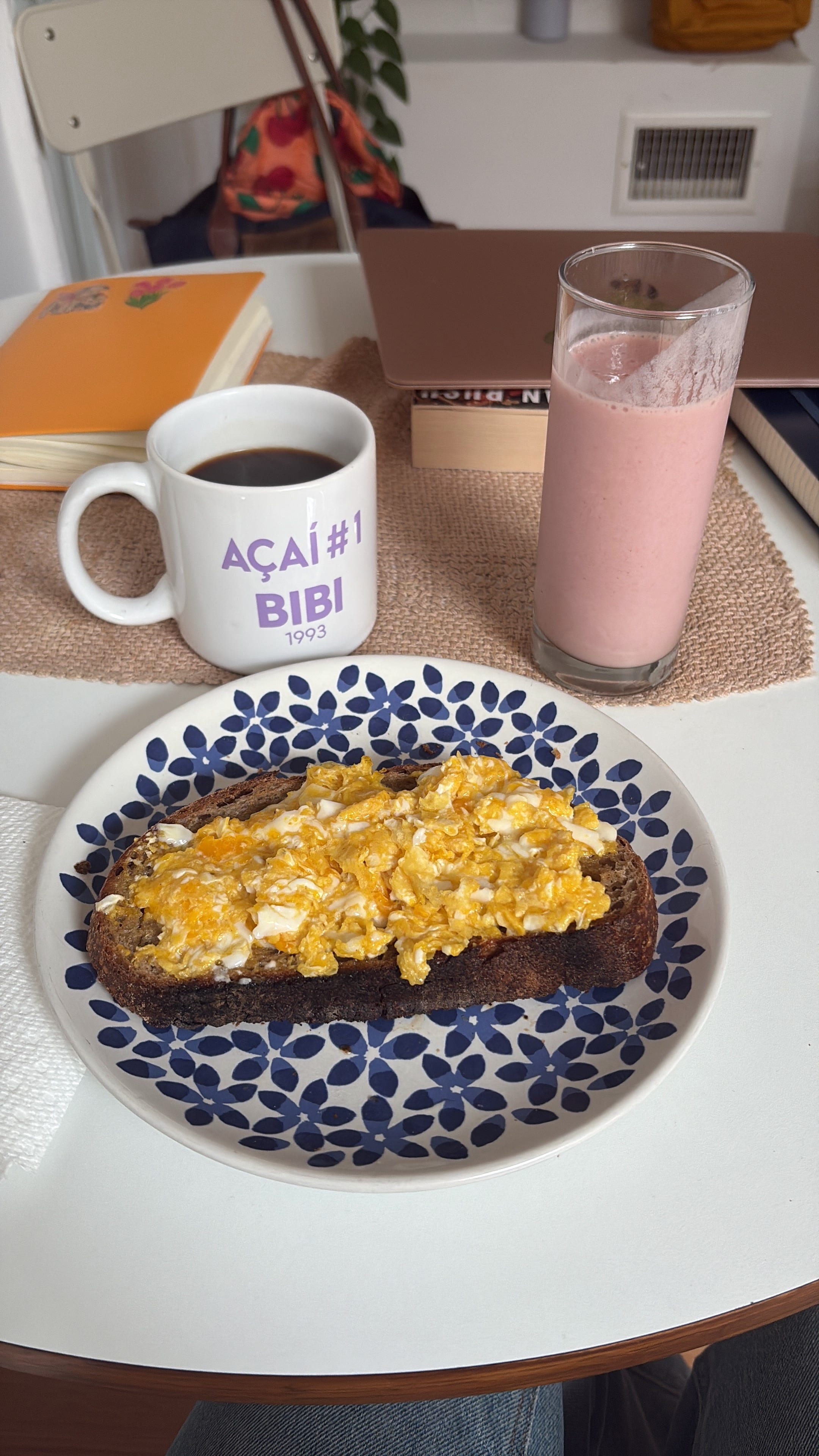
On a hot day, when the skylight in our kitchen has preheated the apartment and the window A.C. unit has just begun waging its valiant battle, I can be persuaded to consume my daily banana in the form of a smoothie. Lately, I’ve taken to using more milk than usual for a liquidier texture, to be consumed more like a drink and less like a meal. In Brazil, we call these vitaminas –– vitamins, for your health. This is how I like mine:
1 frozen banana
2 frozen strawberries (one stall at Grand Army Plaza, I forget which, sells frozen berries under their pastry case –– they come pre-portioned!)
Milk of choice (whole when I’m feeling defiant; almond when I’m feeling insecure) to cover, and then a little…
Squirt of honey
Pinch of salt.